
Texas police cannot search your vehicle during a routine traffic stop solely because an officer pulled you over. A lawful vehicle search generally requires your voluntary consent, probable cause, a warrant, or another recognized exception to the warrant requirement. The reason for the stop, what the officer observes, how long you are detained, and what you say can all affect whether a later search is lawful. The Fourth Amendment and Article I, Section 9 of the Texas Constitution protect you against unreasonable searches and seizures.
If police found drugs, a weapon, or other evidence in your vehicle, the legality of the stop and search may become a central issue in your criminal case. Zendeh Del & Associates PLLC represents people in Galveston, Texas, who need to understand whether a traffic stop, detention, or vehicle search crossed constitutional limits. You can request a consultation to discuss the circumstances of your case.
A traffic stop does not give police automatic authority to search your vehicle. The officer needs consent, probable cause, a warrant, or another lawful basis for the search.
Awards & Media Appearances



















A Routine Traffic Stop Does Not Automatically Authorize a Vehicle Search 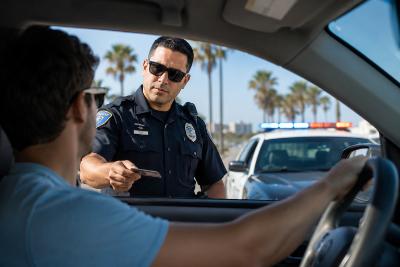
A routine traffic stop is a seizure under the Fourth Amendment. Police generally need a lawful basis to stop your vehicle, such as reasonable suspicion that a traffic law was violated or that criminal activity may be occurring.
During the traffic stop, the officer may complete tasks connected with the traffic violation. Those tasks can include checking your driver license, vehicle registration, proof of insurance, and outstanding warrants. The traffic stop does not give an officer unlimited time to investigate unrelated criminal activity.
In Rodriguez v. United States, the United States Supreme Court held that police generally may not extend a completed traffic stop for an unrelated drug-dog sniff unless additional reasonable suspicion or another lawful basis supports the continued detention. The timing of the stop can become a major issue when you are kept on the roadside after the traffic-related tasks reasonably should have ended.
For more information about criminal investigations and defense in Galveston, visit:
https://www.galvestonjustice.com/galveston-criminal-defense-lawyers/
The Zendeh Del & Associates, PLLC Team








When Can Texas Police Search a Vehicle Without a Warrant?
Texas police may search a vehicle without a warrant when a recognized exception to the warrant requirement applies. Common issues during traffic stops include consent, probable cause under the automobile exception, searches incident to arrest, protective searches for weapons, and inventory searches after lawful impoundment.
Consent to Search Your Vehicle
Police can ask for consent to search your vehicle even when they do not have probable cause. You generally have the right to refuse consent.
You can state clearly: “I do not consent to a search.”
You do not need to argue with the officer or physically interfere with the search. If police search your vehicle after you refuse consent, you can allow a criminal defense lawyer to review the legal basis for the search later.
Consent must be voluntary. A court may examine what the officer said, whether threats or coercion were used, and the circumstances surrounding the request. Consent can also be limited in scope. If police search beyond the permission you gave, the additional search may raise a separate Fourth Amendment issue.
Probable Cause and the Automobile Exception
Probable cause can allow police to conduct a warrantless vehicle search under the automobile exception. Probable cause requires facts and circumstances that would support a reasonable belief that the vehicle contains contraband or evidence of a crime. A hunch alone is not enough.
When probable cause exists, police may search areas of the vehicle, including containers, where the suspected contraband or evidence could reasonably be found. The lawful scope depends on what officers have probable cause to look for. A routine speeding violation by itself does not create probable cause to search your car.
Case Results
Items in Plain View During a Traffic Stop
Items in plain view can affect whether police develop probable cause during a traffic stop. If an officer is lawfully positioned outside your vehicle and observes an item whose incriminating nature is immediately apparent, that observation may support further lawful action.
For example, if an officer lawfully approaches your vehicle and sees suspected contraband in an open area, the officer may claim that the observation contributes to probable cause. Whether that claim is valid depends on what the officer saw, where the officer was located, and the surrounding facts.
Can Police Search Your Car After an Arrest?
Police cannot conduct a full vehicle search merely because you were arrested. A search incident to arrest is limited by the rule explained in Arizona v. Gant.
Under Gant, police may search the passenger compartment incident to the arrest of a recent occupant when the arrested person is unsecured and within reaching distance of the passenger compartment at the time of the search. Police may also conduct such a search when it is reasonable to believe that the vehicle contains evidence relevant to the offense of arrest.
A different legal basis may still authorize a search after an arrest, including probable cause under the automobile exception, valid consent, a warrant, or another recognized exception. The facts determine whether the search was lawful.
Can Police Search Your Vehicle for Weapons During a Stop?
Police may conduct a limited protective search of your vehicle for weapons when officer-safety requirements are met.
Under Michigan v. Long, an officer may conduct a protective search of the passenger compartment when specific facts support a reasonable belief that you are dangerous and may gain immediate control of a weapon. This protective vehicle search is limited to areas where a weapon could be placed or hidden. It is not a general search for evidence.
What Happens When Police Use a Drug Dog During a Traffic Stop?
A drug-dog sniff around the exterior of a vehicle is treated differently from a physical search of the vehicle. The timing of the drug-dog sniff is often the central issue.
If a trained dog is used while the officer is still lawfully completing the traffic stop, the sniff may occur without unlawfully prolonging the detention. If the traffic-related mission has ended and police keep you detained only to wait for a dog, Rodriguez v. United States requires an independent lawful basis, such as reasonable suspicion, for the additional detention.
A sufficiently reliable dog alert can support probable cause under the totality of the circumstances. A defense lawyer may review the dog’s training and certification records, the deployment, the handler’s conduct, the timing of the sniff, and available video evidence when evaluating the claimed probable cause.
Can Police Search an Impounded Vehicle?
Police may conduct an inventory search after your vehicle has been lawfully impounded. Inventory searches are generally used to document property, protect belongings, protect the agency from property claims, and identify dangerous items.
An inventory search must follow lawful impoundment and should be conducted under standardized police procedures. It cannot be used as a substitute for an investigative evidence search. A criminal defense lawyer may examine why the vehicle was impounded, the department policy, whether officers followed that policy, and what the officers did during the inventory.
What Should You Do If an Officer Asks to Search Your Car?
If an officer asks to search your car, you can protect your rights without arguing or physically resisting. The roadside is not the place to litigate whether a search is constitutional.
Practical steps include:
- Keep your hands visible and follow lawful safety instructions.
- Provide the driver license, registration, insurance information, or other documents that the law requires.
- State clearly, “I do not consent to a search,” if you do not want to consent.
- Do not physically resist if officers search the vehicle anyway.
- Do not make false statements about ownership, contraband, or other facts.
- Ask whether you are free to leave if the traffic-related purpose of the stop appears complete.
- Write down what happened after the encounter while the details are still fresh.
- Preserve any photographs, videos, citations, towing paperwork, or other records connected with the stop.
If the traffic stop develops into a DWI investigation, visit:
https://www.galvestonjustice.com/galveston-dwi-lawyers/
What Happens If a Texas Vehicle Search Was Illegal?
If a Texas vehicle search was illegal, evidence obtained from the search may be challenged through a motion to suppress. Texas Code of Criminal Procedure Article 38.23 generally bars evidence obtained in violation of the United States Constitution, the Texas Constitution, or Texas law. Article 38.23 also contains a good-faith exception for certain evidence obtained by an officer acting in objective good-faith reliance on a warrant issued by a neutral magistrate based on probable cause.
A criminal defense lawyer may review:
- Why police stopped your vehicle.
- What the officer knew before initiating the stop.
- How long the traffic detention lasted.
- Whether police requested or claimed consent.
- What you and the officer said before the search.
- Body-camera and dash-camera footage.
- Dispatch records and timestamps.
- The facts police relied on to claim probable cause.
- Where officers found the evidence.
- Whether officers searched beyond the lawful scope.
- Whether an impoundment and inventory search followed standardized procedures.
If a court suppresses important evidence, the prosecution may have less evidence available to prove the charge. Suppression does not automatically require dismissal. The effect depends on the charge and the evidence that remains admissible.
For more information about Fourth Amendment protections, visit:
Why Galveston Traffic Stop and Vehicle Search Cases Require a Fact-Specific Review
Galveston traffic stop and vehicle search cases require a fact-specific review because a minor traffic issue can develop into a drug, weapon, DWI, or other criminal investigation. Stops on Broadway Avenue, Seawall Boulevard, Interstate 45, and other roadways in Galveston and nearby areas can raise different legal questions depending on what happened before, during, and after the stop.
The sequence of events matters. A lawyer may need to determine what the officer knew before stopping you, what developed during the detention, when the traffic mission reasonably should have ended, what was said before the search, and whether police developed an independent lawful basis to continue the investigation.
Video evidence can be especially useful because it may show the timing of the encounter, officer instructions, your responses, the location of objects, and whether the written police report matches what occurred.
Speak With a Galveston Criminal Defense Attorney About a Vehicle Search
If police searched your vehicle during a traffic stop in Galveston, Texas, a Galveston criminal defense attorney can review the stop, detention, consent issue, claimed probable cause, police video, and evidence recovered from your vehicle.
With its main office in Galveston, Zendeh Del & Associates PLLC represents people facing criminal allegations in Galveston and nearby areas. The firm can review the circumstances of the search and explain the legal issues that may affect your case.
Call (409) 215-7500 or use:
tel:+14092157500
Learn more about attorney Jonathan Zendeh Del:
https://www.galvestonjustice.com/attorney-jonathan-zendeh-del/
Contact Zendeh Del & Associates PLLC:
https://www.galvestonjustice.com/contact-us/
This article is for informational purposes only and is not legal advice. Consult an attorney about your specific situation.