
A bicycle accident in Galveston can leave you dealing with medical treatment, missed work, bicycle damage, and pressure from an insurance company. Texas law generally gives bicyclists the rights and duties that apply to motor vehicle drivers, but responsibility depends on the actions of the rider, driver, and any other party connected to the crash.
The first steps you take can affect your health and your claim. Get medical care, report the collision, photograph the scene, identify witnesses, preserve your bicycle and riding gear, and avoid guessing when an insurer asks questions. A claim may involve a careless driver, a vehicle owner, an employer, a delivery or rideshare business, a bicycle or component manufacturer, a property owner, a contractor, a maintenance provider, or a public entity.
Zendeh Del & Associates PLLC helps injured riders understand how evidence, insurance coverage, Texas fault rules, and filing deadlines may affect a claim. You can also review the firm’s Galveston bicycle accident lawyers page for information about legal representation after a cycling collision.
Awards & Media Appearances


















How Galveston Bicycle Accident Claims Work 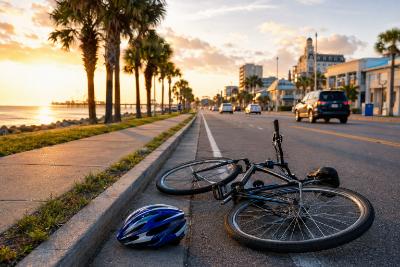
Most bicycle accident claims are based on negligence. You generally need evidence showing that another party owed you a duty of reasonable care, failed to meet that duty, and caused your injuries and losses.
Common bicycle crash scenarios in Galveston include:
- A driver turning right across your path
- A motorist failing to yield at an intersection
- A vehicle drifting into your travel lane
- A driver opening a parked vehicle door into your path
- A motorist passing too closely
- A distracted driver looking at a phone or navigation screen
- A commercial driver making an unsafe turn
- A bicycle or component failing during normal use
- Loose material, a pavement defect, or an unsafe work zone contributing to a crash
The facts of the collision determine which legal theories and insurance policies may apply. A police report can provide useful information, but it does not always include every witness, camera, road condition, or contributing act.
You can learn more about the broader injury process on the firm’s Galveston personal injury lawyers page. When your collision involves a passenger vehicle, the Galveston car accident lawyers page provides more information about insurance and crash evidence.
The Zendeh Del & Associates, PLLC Team






Texas Bicycle Rules Can Affect Your Claim
Texas Transportation Code Section 551.101 generally gives you the rights and duties that apply to a motor vehicle driver unless a bicycle-specific rule changes them or a rule cannot reasonably apply to a bicycle. You must follow applicable traffic signals, right-of-way rules, and roadway requirements.
Texas Transportation Code Section 551.103 addresses where a slower-moving bicyclist should ride. The law also recognizes exceptions when you are passing, preparing for a left turn, avoiding unsafe conditions, or traveling in a lane that is too narrow for a bicycle and motor vehicle to travel safely side by side.
Texas Transportation Code Section 551.104 requires specified lighting and reflective equipment when you ride at nighttime. A bicycle generally must have a white light on the front and a red reflector or red light on the rear that meets the statutory visibility requirements.
Galveston also maintains local bicycle regulations. The rule that applies may depend on where and how the crash occurred.
A claimed traffic violation does not automatically excuse a careless driver. A driver still has a duty to keep a proper lookout, follow traffic laws, and use reasonable care around a person riding a bicycle. Any alleged violation by you becomes one fact in the broader responsibility analysis.
Case Results
What to Do After a Bicycle Crash
Your health comes first. Call 911 when someone may be injured, move out of active traffic when it is safe, and accept medical evaluation. A concussion, fracture, internal injury, or soft-tissue injury may not be fully apparent during the initial shock of a collision.
When circumstances allow:
- Photograph the vehicle, bicycle, roadway, debris, skid marks, traffic signals, signs, and nearby businesses
- Record the driver’s name, insurer, license plate, and contact information
- Ask witnesses for their names and phone numbers
- Note nearby homes, hotels, stores, parking areas, doorbell cameras, and traffic cameras
- Save the police report number and responding officer’s information
- Keep your bicycle, helmet, clothing, lights, cycling computer, and damaged personal items
- Organize medical bills, wage records, receipts, repair estimates, and insurance letters
- Avoid posting crash details or recovery updates on social media
- Follow your medical provider’s instructions and attend recommended appointments
Protect the evidence early. Do not repair or discard your bicycle, helmet, lights, or damaged gear before they have been reviewed.
Damage patterns may help show the angle and force of impact. Electronic ride data, phone location information, photographs, and video may help establish timing, speed, route, visibility, or movement. Save original files when possible because screenshots and edited copies may omit useful data.
Who May Be Responsible for a Bicycle Accident?
The driver is often the first party investigated, but responsibility may extend to other people or businesses. The available evidence and the legal relationship between the parties determine who may be included in a claim.
Potentially responsible parties may include:
- A driver who failed to yield, drove while distracted, passed unsafely, or violated another traffic rule
- A vehicle owner whose actions or legal relationship to the driver create responsibility
- An employer when a worker caused the crash while performing job duties
- A delivery, rideshare, or transportation business connected to the trip
- A contractor or maintenance provider responsible for an unsafe work zone
- A property owner responsible for a dangerous condition
- A bicycle, helmet, or component manufacturer when a defective product contributed to the injury
- A public entity responsible for a roadway or public property condition, subject to applicable legal limits and notice rules
Consider a cyclist riding through a Galveston intersection when a delivery van turns across the cyclist’s path. The driver says that the rider appeared suddenly. A full review may include traffic-camera footage, delivery records, driver phone data, vehicle damage, witness statements, signal timing, and the cyclist’s ride data. Those sources may confirm or challenge the first account.
Claims involving a roadway defect or public property can involve special notice requirements before the ordinary lawsuit deadline. Early review matters because video can be overwritten, vehicles can be repaired, and road conditions can change.
How Texas Shared-Fault Rules Apply
Texas uses a proportionate-responsibility system. Under Texas Civil Practice and Remedies Code Section 33.001, you generally cannot recover damages when your percentage of responsibility is greater than 50 percent. Under Section 33.012, a recovery is generally reduced by your assigned percentage of responsibility when recovery is allowed.
An insurer may argue that you:
- Failed to stop at a traffic signal
- Rode against traffic
- Were difficult to see
- Changed direction without warning
- Used a phone or headphones
- Lacked required nighttime equipment
- Could have avoided the collision
Those claims should be compared with objective evidence. A police report can help, but video, physical damage, witness accounts, road measurements, medical records, electronic data, and expert analysis may affect how fault is evaluated.
For example, a rider found 20 percent responsible may have a recoverable amount reduced by 20 percent. The final percentage depends on the evidence, the parties involved, and the decisions made during settlement or litigation.
Insurance Issues You May Face
The at-fault driver’s bodily injury liability coverage is often a central source of compensation. Other policies may apply based on the facts.
Possible sources of coverage include:
- The driver’s auto liability policy
- A vehicle owner’s policy
- An employer’s commercial auto or liability policy
- Uninsured or underinsured motorist coverage
- Medical payments coverage
- Health insurance
- A business or property insurance policy
- Product liability coverage connected to a defective bicycle or component
A hit-and-run crash can create added difficulty, but it does not always eliminate a claim. Report the collision promptly, preserve the available evidence, and review any uninsured motorist coverage that may apply. Policy notice, proof, and cooperation requirements may affect coverage.
An adjuster may request a recorded statement soon after the crash. Give accurate identifying and basic incident information, but do not guess about distance, speed, visibility, fault, or the full extent of your injuries. Some symptoms develop later, and an incomplete early statement may be used to dispute your claim.
Do not sign a medical authorization, release, or settlement agreement until you understand its scope. A broad authorization may allow access to medical information beyond the treatment related to the crash. A signed release may end your right to seek further compensation.
Losses That May Be Included in Your Claim
The value of a Galveston bicycle accident claim depends on the evidence, available insurance, injury severity, medical outlook, work effects, property damage, and percentage of responsibility assigned to each party.
Recoverable losses may include the following when supported by evidence:
- Ambulance, emergency room, hospital, and physician bills
- Surgery, therapy, medication, and future medical care
- Lost wages and reduced earning capacity
- Bicycle repair or replacement
- Damage to your helmet, clothing, electronics, and riding equipment
- Physical pain and mental anguish
- Physical impairment
- Scarring or disfigurement
- Other reasonable accident-related expenses
A claim’s value cannot be determined from one bill or diagnosis alone. The review should account for your full medical course, work restrictions, future needs, property losses, and the day-to-day effect of your injuries.
When a bicycle collision results in death, qualifying family members and the estate may need information about wrongful death and survival claims. The firm’s Galveston wrongful death lawyers page explains related legal issues.
How Long Do You Have to File a Bicycle Accident Lawsuit?
Texas Civil Practice and Remedies Code Section 16.003 generally requires a personal injury lawsuit to be filed within two years after the claim accrues. Different rules or exceptions may shorten, extend, or otherwise change the deadline. Claims involving a government entity may also have earlier notice requirements.
Two years may sound like ample time, but evidence can disappear within days or weeks. A nearby business may overwrite surveillance footage. Witnesses may become harder to locate. Your bicycle or the vehicle may be repaired, sold, or destroyed. Medical records, billing documents, and wage evidence also take time to collect.
The safest approach is to have the deadline reviewed based on the exact facts of your collision. Do not assume that the general two-year period controls every claim.
How a Galveston Bicycle Accident Attorney Can Help
A lawyer can investigate the collision, preserve evidence, identify potentially responsible parties, review insurance coverage, evaluate shared-fault allegations, document your losses, and communicate with insurers.
Legal counsel may also:
- Send preservation requests for video, electronic data, vehicles, and business records
- Obtain police reports, photographs, medical records, and witness statements
- Review commercial driving, delivery, employment, or maintenance records
- Examine insurance policies and coverage disputes
- Work with medical, accident reconstruction, economic, or vocational professionals when needed
- Evaluate settlement offers and releases
- File a lawsuit when litigation is needed to protect the claim or obtain evidence
Information about attorney Jonathan Zendeh Del is available on his attorney profile.
Speak With a Galveston Bicycle Accident Attorney
A bicycle crash can affect your health, work, transportation, and family life. Zendeh Del & Associates PLLC offers free consultations to injured riders who need help understanding their legal options, insurance questions, and next steps.
The firm serves injured people in Galveston, Texas, and nearby areas. Call (409) 215-7500 or use the firm’s Galveston office contact page to discuss your situation.
This article is for informational purposes only and is not legal advice. Every case is different. Consult an attorney about your specific circumstances.

|
|

 |