
Police and prosecutors in a Texas DWI case may use driving behavior, officer observations, statements, field sobriety tests, body-camera and dash-camera video, breath or blood results, witness accounts, crash evidence, and digital records. Texas law does not require a chemical test in every DWI prosecution because intoxication may be alleged through loss of normal mental or physical faculties or an alcohol concentration of 0.08 or more.
If you were arrested for DWI in Galveston, Texas, the evidence should be reviewed as a complete timeline. Your attorney may compare police reports with video, testing records, witness accounts, medical information, dispatch records, and the legal basis for the stop, detention, arrest, or specimen collection.
No single piece of evidence automatically decides every case. A breath result, blood result, field sobriety performance, officer opinion, or refusal still must be evaluated in context.
DWI evidence should be reviewed as a complete timeline, not as isolated facts.
Awards & Media Appearances

















What Must the State Prove in a Texas DWI Case? 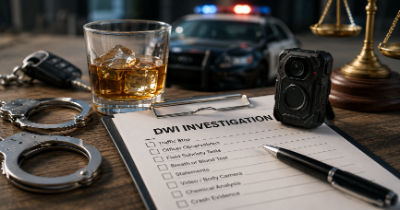
In a Texas DWI case, the State must prove that you were intoxicated while operating a motor vehicle in a public place. Texas Penal Code Section 49.04 defines the offense, while Section 49.01 defines intoxication in two ways. The State may try to prove that you did not have the normal use of mental or physical faculties because of alcohol, drugs, a combination of substances, or another substance. The State may also try to prove an alcohol concentration of 0.08 or more.
That means a prosecutor may build a DWI case with or without a breath or blood result. The evidence is usually evaluated as a timeline showing what happened before the stop, during the roadside investigation, after arrest, and during chemical testing.
Learn more about the broader DWI process:
https://www.galvestonjustice.com/galveston-dwi-lawyers/
Driving Behavior and the Reason for the Stop
Driving behavior and the reason for the stop can become important parts of a DWI case. An officer may describe speeding, delayed braking, unusual lane movement, a wide turn, failure to signal, a collision, or another traffic issue.
The reason for the stop matters because police generally need a lawful basis to detain a driver. Your attorney may compare the officer’s written description with dash-camera footage, roadway markings, traffic conditions, dispatch information, and the timing of the alleged violation.
Driving behavior may also be offered as circumstantial evidence of impairment. Conduct that appears suspicious in a report can still have another explanation, such as road construction, another vehicle, poor visibility, fatigue, distraction, unfamiliar streets, or a mechanical problem.
The Zendeh Del & Associates, PLLC Team






Officer Observations
Officer observations often appear in DWI reports. An officer may note:
- Odor of alcohol
• Red or watery eyes
• Slurred or unusual speech
• Difficulty locating a license or insurance card
• Unsteady movement
• Confusion or slow responses
• Open containers or visible substances
These observations may support the State’s case, but they do not automatically prove intoxication. Allergies, fatigue, anxiety, contact lenses, injuries, medical conditions, medications, or the stress of a traffic stop may affect how you look, speak, or move.
Body-camera footage can help test the accuracy and context of officer observations. It may show clear speech, normal coordination, calm responses, or details that do not appear in the report. It may also support the officer’s account.
Statements You Make to Police
Statements you make to police can become evidence in a DWI case. Officers may ask where you were coming from, whether you drank alcohol, when you had your last drink, whether you used prescription medication, who was driving, or what happened before a crash.
An admission that you consumed alcohol is not the same as an admission that you were intoxicated while driving. Timing and exact wording matter. Whether a statement is admissible can also depend on detention, custody, interrogation, and the circumstances under which the statement was obtained.
Case Results
Field Sobriety Test Evidence
Field sobriety test evidence is commonly used during Texas DWI investigations. Standardized field sobriety tests may include:
- Horizontal gaze nystagmus
• Walk-and-turn
• One-leg stand
Officers are trained to look for specific clues during each test. Field sobriety testing is not a laboratory measurement of alcohol concentration. Performance can be affected by physical limitations, balance problems, footwear, injuries, age, fatigue, uneven pavement, lighting, traffic, distractions, and the instructions given by the officer.
Your attorney may review whether the officer demonstrated the test correctly, followed standardized procedures, counted clues accurately, and documented conditions that could affect performance.
More information about field sobriety testing:
https://www.galvestonjustice.com/galveston-failed-field-sobriety-test-attorneys/
Body-Camera, Dash-Camera, and Surveillance Video
Body-camera, dash-camera, and surveillance video can provide a direct record of events in a DWI investigation. Police may use video to show driving, speech, balance, field sobriety performance, statements, vehicle condition, or behavior after arrest.
Your defense attorney may use the same footage to identify inconsistencies, missing instructions, normal behavior, timing issues, or differences between the written report and the recording. Other video may come from businesses, parking facilities, residences, hotels, or traffic cameras.
In Galveston, Texas, a case involving a restaurant, hotel, beach area, parking lot, or entertainment district may include footage that helps establish who drove, when a vehicle moved, or what a person was doing before police arrived.
Breath Test Results
Breath test results can be significant when the State alleges an alcohol concentration of 0.08 or more. A breath result still should be reviewed in context.
Questions may include:
- Was the instrument operating properly?
• Were required testing procedures followed?
• Was the operator qualified?
• Was the testing sequence valid?
• Does the timing support an inference about alcohol concentration when the vehicle was operated?
A breath result obtained later does not remove the need to connect the evidence to the time of driving. Chemical testing is one part of the evidentiary picture that may be considered with observations, video, statements, and other facts.
Blood Test and Toxicology Evidence
Blood test and toxicology evidence may be used in alcohol-related DWI cases and in cases involving drugs or combined substances. A laboratory may test a specimen for alcohol, controlled substances, prescription medications, or other compounds.
Your attorney may examine:
- Whether the specimen was obtained lawfully
• Who drew the specimen
• How the specimen was labeled, sealed, stored, and transported
• Whether the chain of custody was documented
• Which laboratory method was used
• Whether calibration and quality-control procedures were followed
In a drug-related case, the presence of a substance does not always answer whether it caused loss of normal mental or physical faculties. Timing, medical history, officer observations, toxicology interpretation, concentration, and other evidence may matter.
Learn more about drug-related DWI defense:
https://www.galvestonjustice.com/galveston-duid-lawyers/
Refusal Evidence
Refusal evidence may be used after certain DWI arrests in Texas. Texas has an implied-consent law, and a refusal of a requested breath or blood specimen may be introduced as evidence at trial. A refusal can also trigger separate driver-license consequences.
A refusal does not automatically prove intoxication. The State may argue that the refusal supports its theory, while the defense may examine confusion, medical concerns, the wording of the request, or the surrounding circumstances. Police may also seek a warrant for a blood specimen when the law permits.
Witnesses, 911 Calls, Crash Evidence, and Digital Records
Witnesses, 911 calls, crash evidence, and digital records may help police build a DWI timeline even when an officer did not personally see the driving. Evidence may include:
- Witness statements
• 911 recordings
• Surveillance video
• Crash damage and debris
• Vehicle location
• Receipts
• Parking records
• Lawfully obtained digital records
For example, if a vehicle is found after a crash and the suspected driver is nearby, the State may try to connect that person to operation through statements, witness observations, injuries, location information, vehicle ownership, or video. Your attorney may examine whether another person could have driven, whether identification is reliable, and whether the timeline contains gaps.
How a DWI Attorney Reviews the Evidence
A DWI attorney reviews the evidence by looking at both the facts and the legal procedures used to obtain them. Your lawyer may review:
- The legal basis for the traffic stop
• The length and scope of the detention
• Probable cause for arrest
• Field sobriety test instructions and scoring
• Breath or blood testing procedures
• Search and warrant issues
• Body-camera and dash-camera footage
• Video preservation
• Chain of custody
• Witness reliability
• Whether the evidence proves intoxication while operating a vehicle in a public place
A careful review may identify evidence that supports the State, evidence that supports the defense, and evidence that requires additional investigation.
Broader criminal defense information:
https://www.galvestonjustice.com/galveston-criminal-defense-lawyers/
Attorney Jonathan Zendeh Del’s background:
https://www.galvestonjustice.com/attorney-jonathan-zendeh-del/
Speak With a Galveston DWI Attorney
A Galveston DWI attorney can review how the evidence in your case was collected, what it may prove, and what legal challenges may apply. Zendeh Del & Associates PLLC represents people facing DWI allegations in Galveston, Texas, and nearby areas.
If you were arrested for DWI, the firm can review police video, field sobriety testing, breath or blood evidence, witness accounts, and the arrest timeline.
Contact Zendeh Del & Associates PLLC:
https://www.galvestonjustice.com/contact-us/
Call (409) 215-7500:
tel:+14092157500
This article is for informational purposes only and is not legal advice. Consult an attorney about your specific situation.

|
|

 |